Back to Articles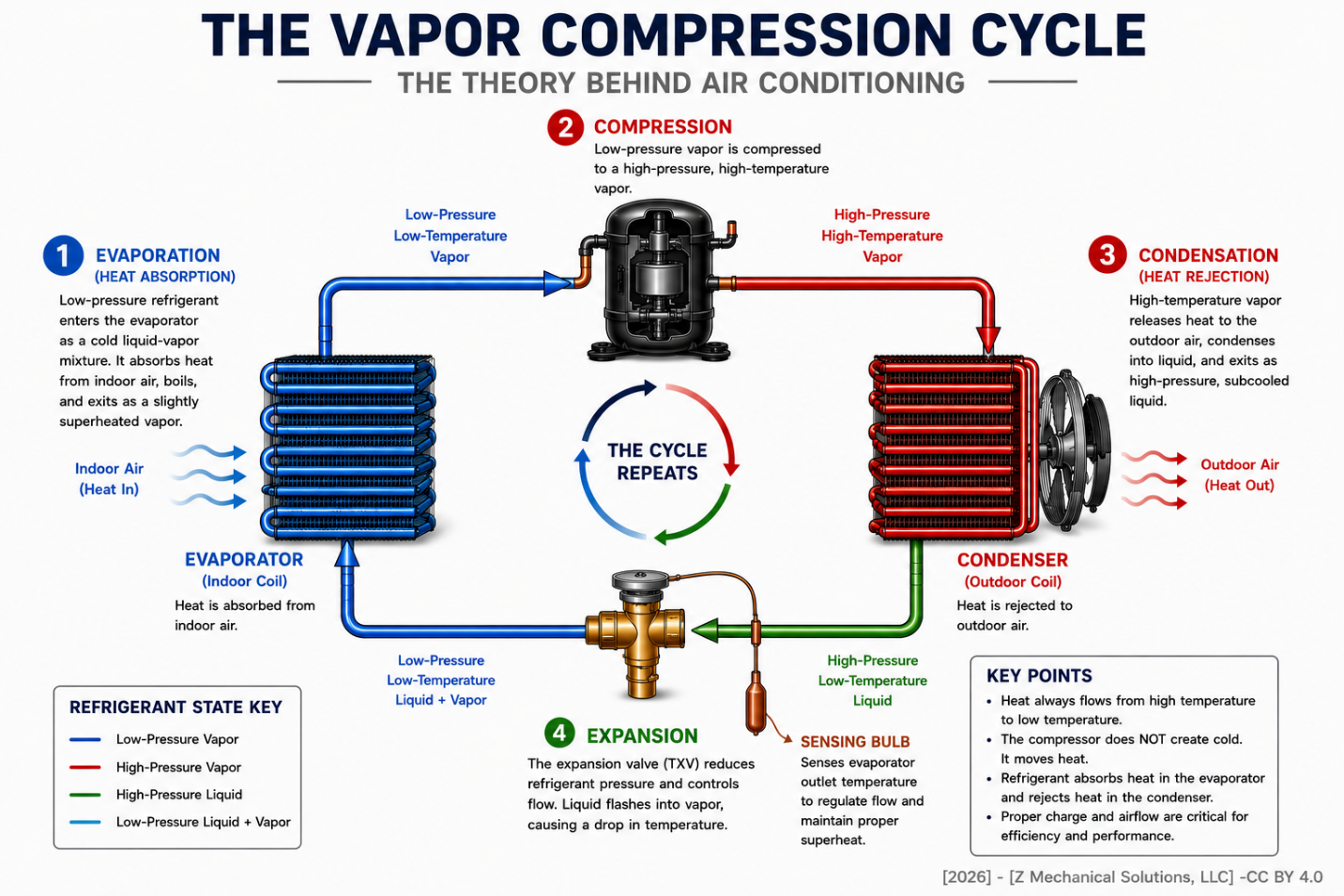
Technical Article
Vapor Compression Cycle – Theory Behind Air Conditioning
By Erfan Zahraei – B.S.M.E. – Founder of Z Mechanical Solutions
Introduction
Nearly every residential air conditioner, heat pump, refrigerator, and commercial refrigeration system operates using the vapor compression refrigeration cycle. Although commonly referred to as "air conditioning," these systems do not create cold air. Instead, they transfer heat from one location to another using the principles of thermodynamics and the unique properties of refrigerants.
Understanding the vapor compression cycle is fundamental for HVAC technicians, engineers, and anyone seeking to understand how modern heating and cooling equipment functions.
Heat Always Moves Toward Cold
Click to enlarge 🔍
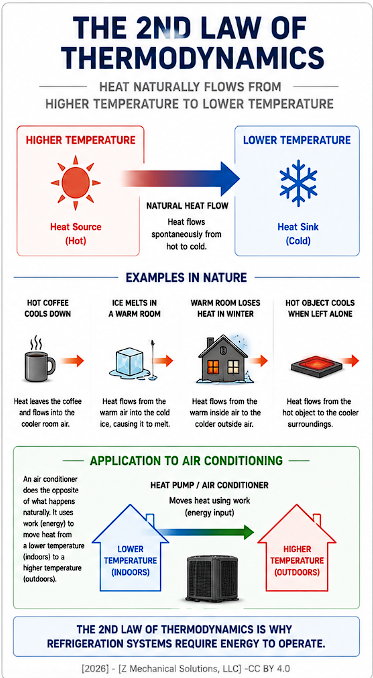
According to the Second Law of Thermodynamics, heat naturally flows from a higher temperature object to a lower temperature object.
For Example
- A hot cup of coffee cools down.
- Ice melts in a warm room.
- A warm home loses heat during winter.
An air conditioner performs the opposite process—it moves heat from a cooler indoor environment to a warmer outdoor environment. This requires external work supplied by the compressor.
The Four Major Components
Click to enlarge 🔍
Every vapor compression system consists of four primary components:
- Compressor
- Condenser
- Expansion Device (TXV, EEV, or Fixed Orifice)
- Evaporator
These four components continuously circulate refrigerant through a closed-loop system.
Step 1 – Evaporation (Heat Absorption)
Click to enlarge 🔍
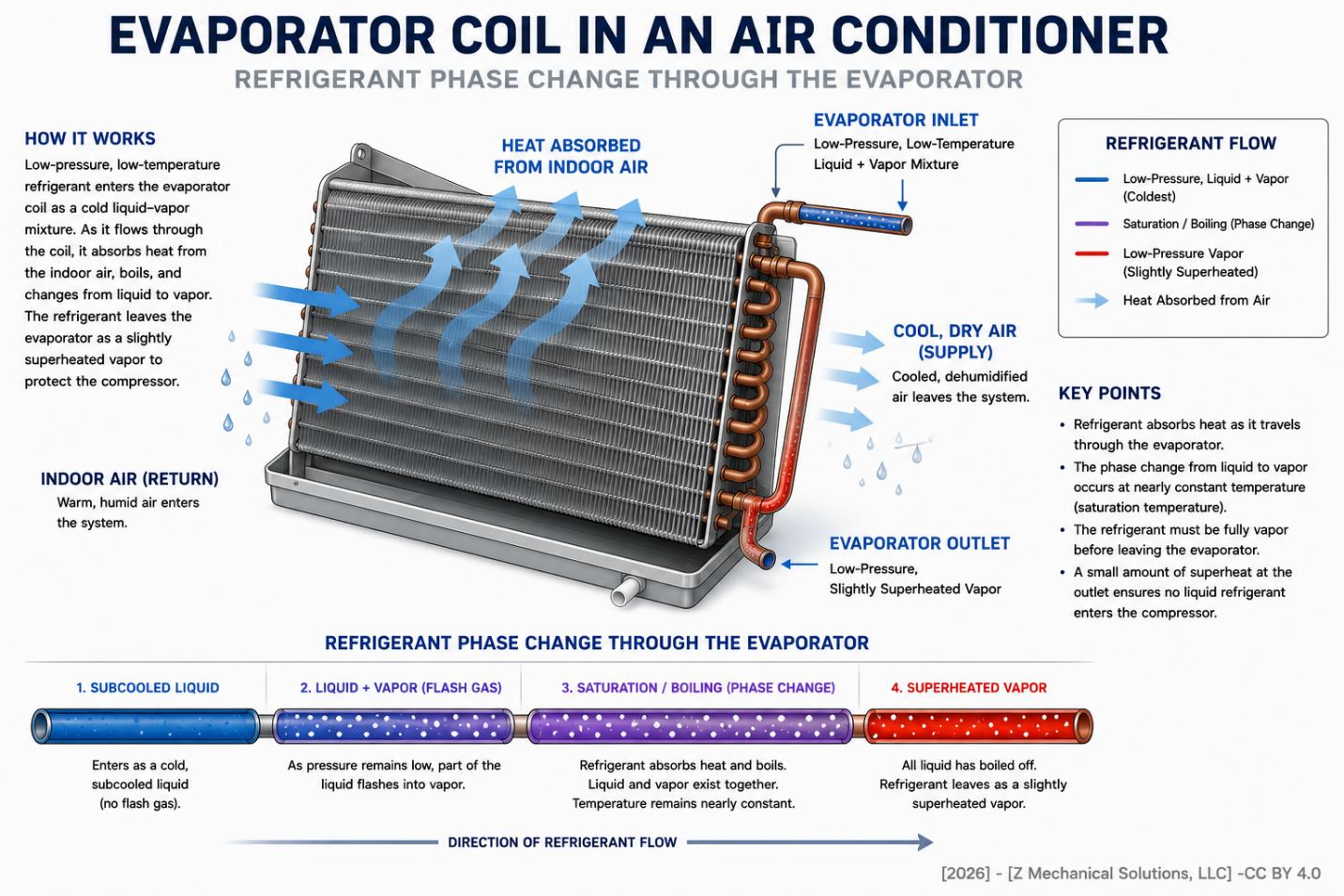
The refrigeration cycle begins inside the evaporator.
Here, a low-pressure mixture of liquid and vapor refrigerant enters the evaporator coil.
Because the refrigerant is at a very low pressure, its boiling point is well below room temperature. As warm indoor air passes across the evaporator coil, heat transfers into the refrigerant.
The refrigerant absorbs latent heat, boils, and changes from a liquid into a vapor.
This is where cooling occurs.
The indoor fan simply moves warm room air across the cold evaporator coil.
Result:
- Heat leaves the building.
- Moisture condenses from the air.
- Cooler, drier air is delivered back into the conditioned space.
The refrigerant should leave the evaporator as slightly superheated vapor, ensuring that no liquid refrigerant reaches the compressor.
Step 2 – Compression
Click to enlarge 🔍
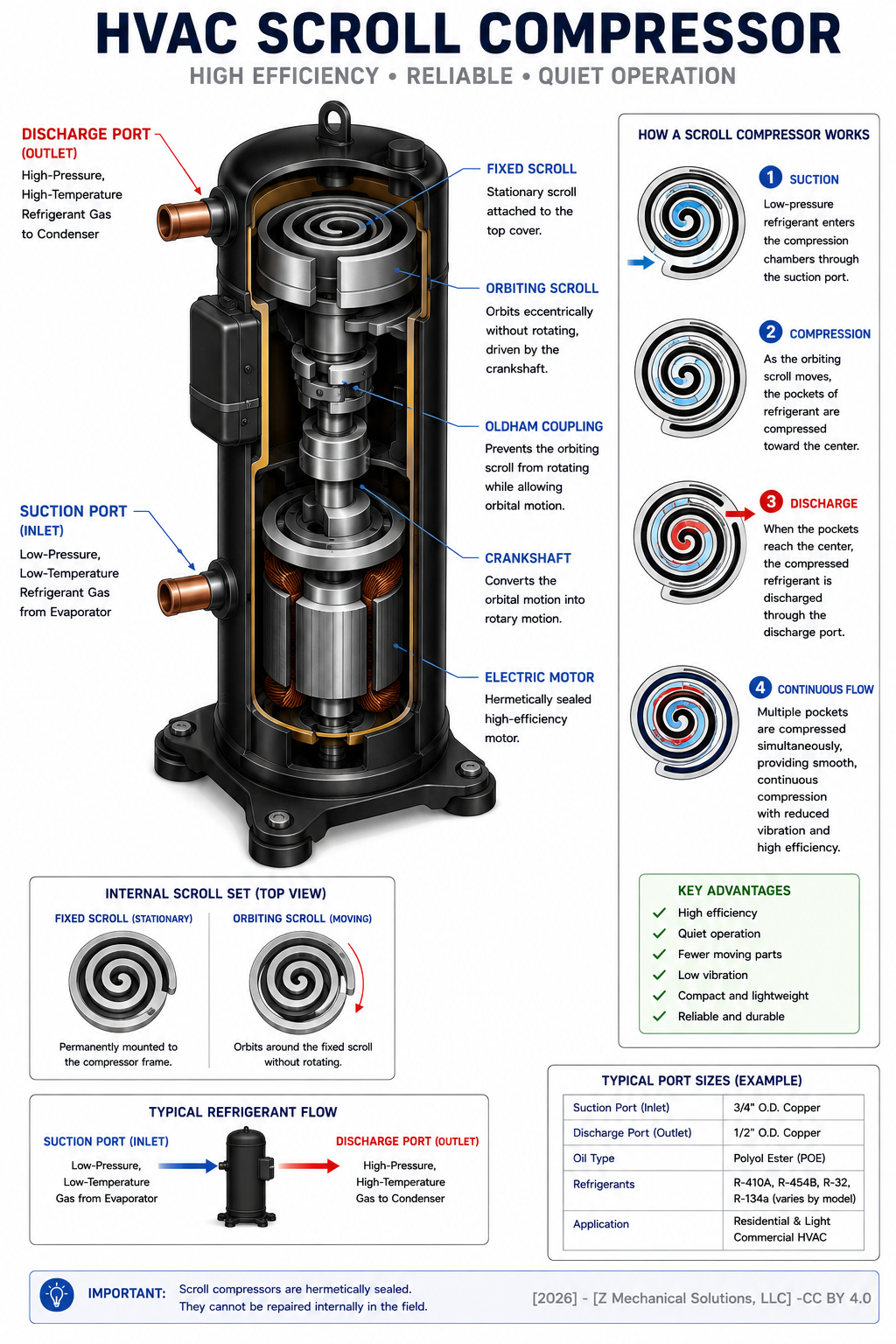
The compressor is often called the heart of the refrigeration system.
Its job is not to create cooling.
Its job is to:
- Raise refrigerant pressure
- Raise refrigerant temperature
- Maintain refrigerant circulation
The compressor draws in low-pressure vapor from the evaporator and compresses it into a high-pressure, high-temperature vapor.
Compression adds energy to the refrigerant, making it hotter than the surrounding outdoor air.
This temperature increase is what allows heat to be rejected in the condenser.
Step 3 – Condensation (Heat Rejection)
Click to enlarge 🔍
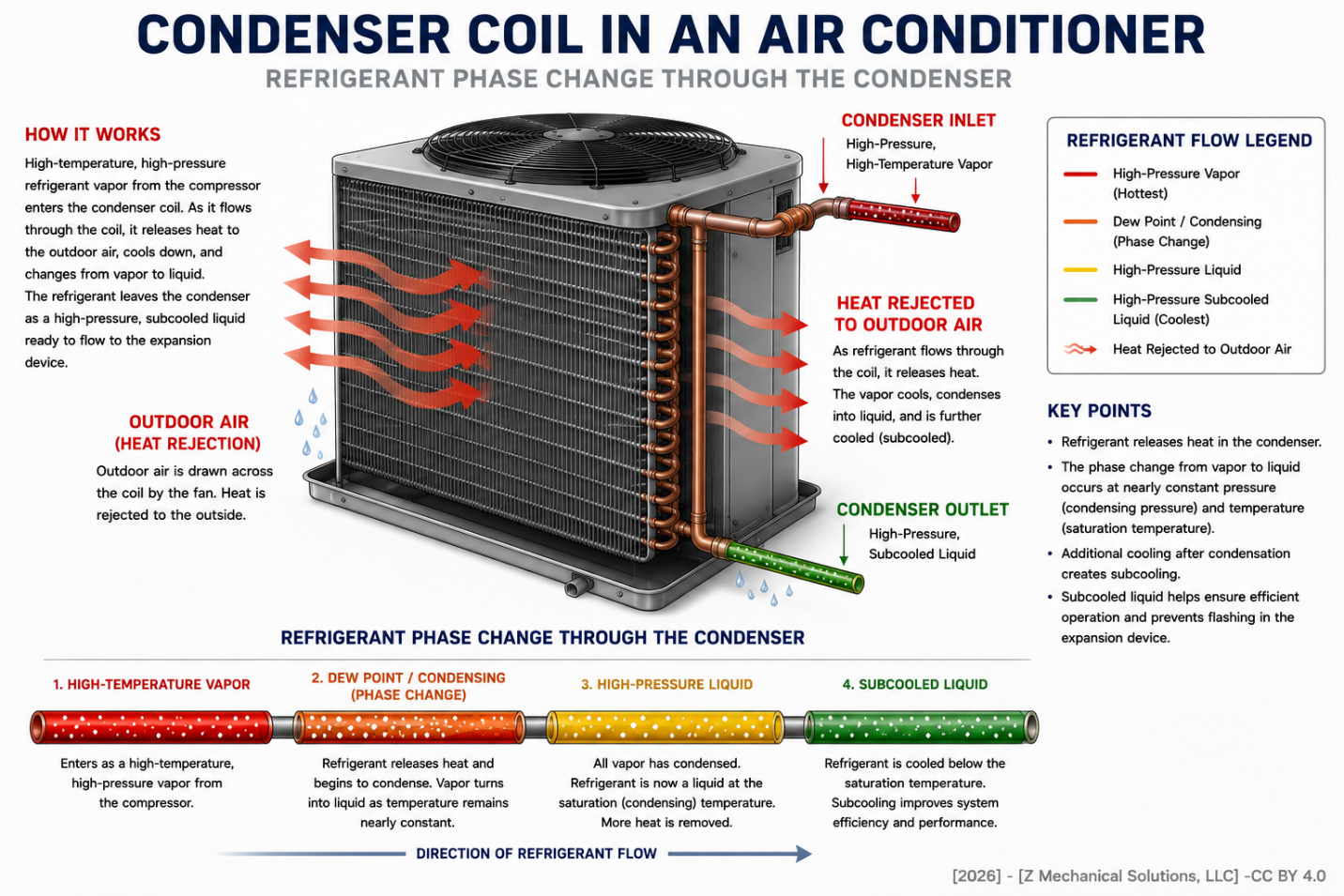
The hot refrigerant vapor now enters the outdoor condenser coil.
Outdoor air, moved by the condenser fan, passes across the coil.
Because the refrigerant temperature is higher than the outdoor air temperature, heat naturally transfers outdoors.
As heat is removed:
- The vapor cools.
- It condenses into a liquid.
- Additional cooling produces subcooled liquid refrigerant, improving system efficiency and ensuring only liquid enters the expansion device.
Step 4 – Expansion
Click to enlarge 🔍
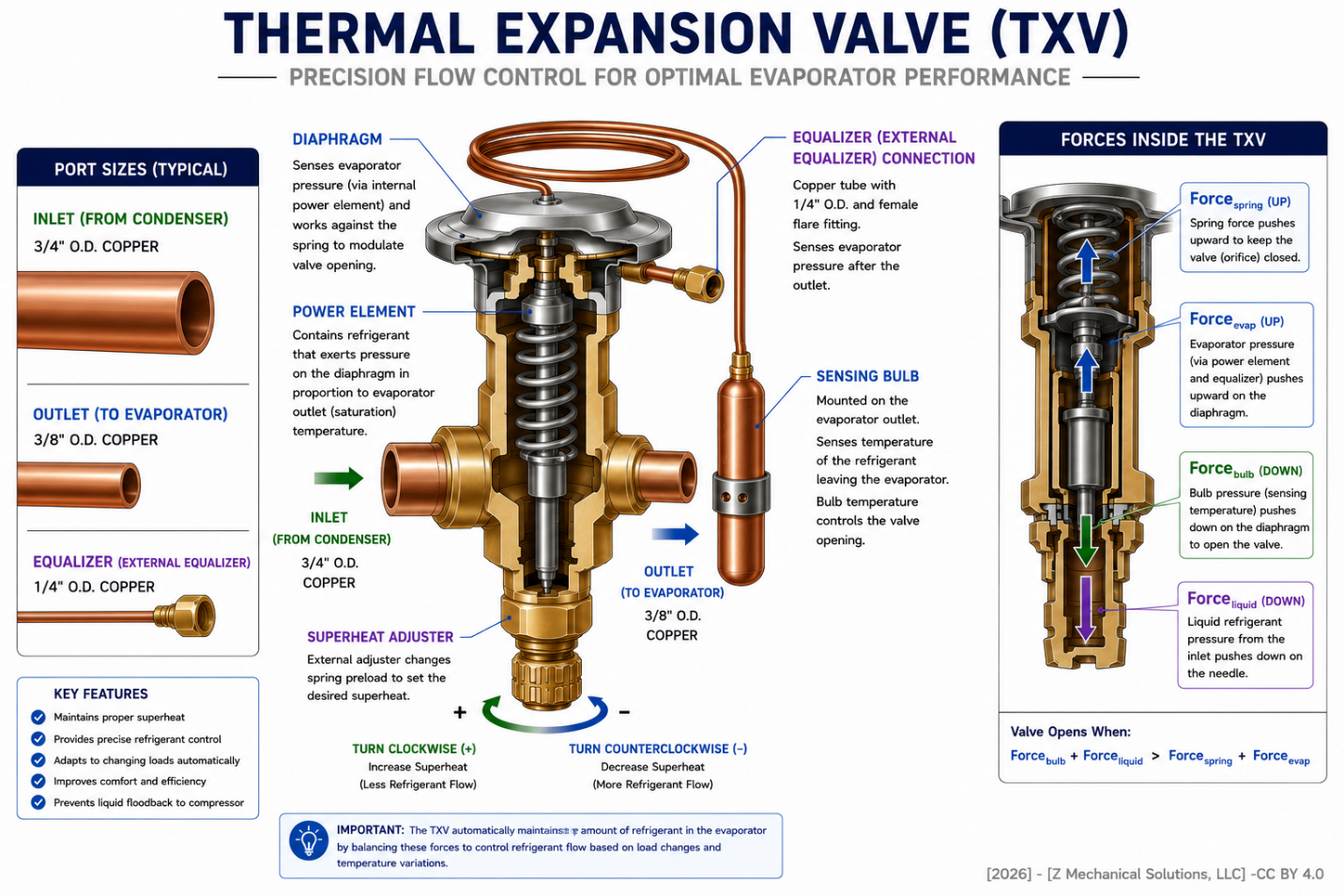
The high-pressure liquid refrigerant next passes through a metering device.
Common devices include:
- Thermostatic Expansion Valve (TXV)
- Electronic Expansion Valve (EEV)
- Fixed Orifice
- Capillary Tube
The expansion device creates a large pressure drop.
As pressure decreases:
- The refrigerant's saturation temperature drops.
- A portion of the liquid flashes into vapor.
- The refrigerant becomes a cold, low-pressure liquid-vapor mixture ready to absorb heat once again in the evaporator.
The expansion device meters refrigerant flow while maintaining proper evaporator operation.
In the illustration shown above, the thermal expansion valve model is used. The thermal expansion valve has a sensing bulb (a copper sealed bulb containing a trace amount of refrigerant). This bulb heats up with suction line increases in temperature, increasing bulb pressure, pressing DOWN on the spring inside the TXV, opening it to allow liquid refrigerant to become flash-gas and come OUT the TXV. In addition, the force of the liquid refrigerant entering the TXV pushes down on the spring inside the TXV. The force of the evaporator pressure from the equalizer tube, AND the force of the spring act UPWARDS to close the orifice.
Understanding Pressure and Temperature
Click to enlarge 🔍
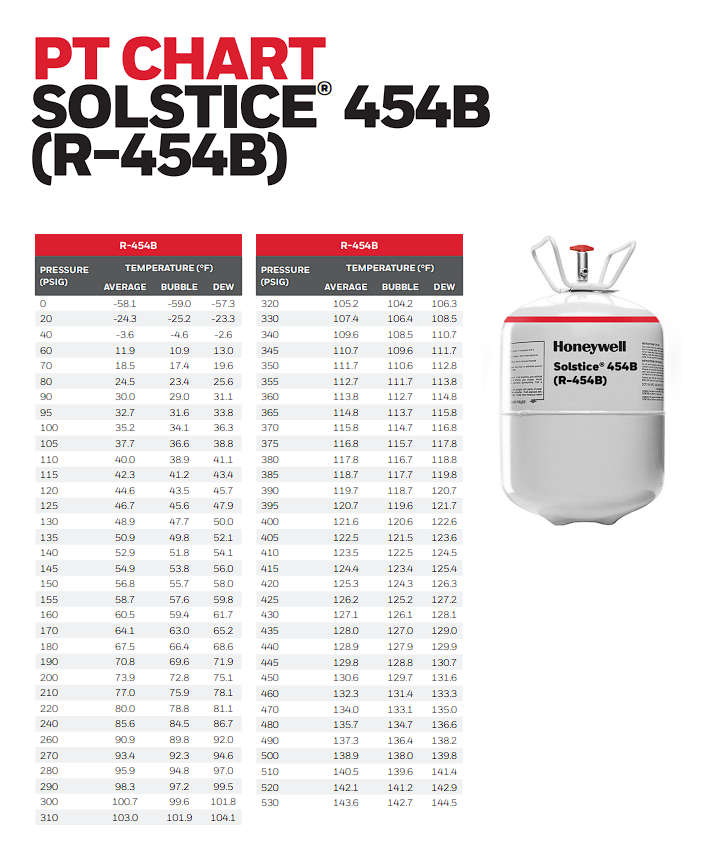
One of the most important concepts in refrigeration is that pressure determines saturation temperature.
Higher pressure corresponds to a higher boiling and condensing temperature.
Lower pressure corresponds to a lower boiling temperature.
For example:
- The evaporator operates at low pressure so refrigerant boils at a temperature below the indoor air temperature.
- The condenser operates at high pressure so refrigerant condenses at a temperature above the outdoor air temperature.
This relationship allows the system to absorb heat indoors and reject it outdoors.
Superheat and Subcooling
Click to enlarge 🔍
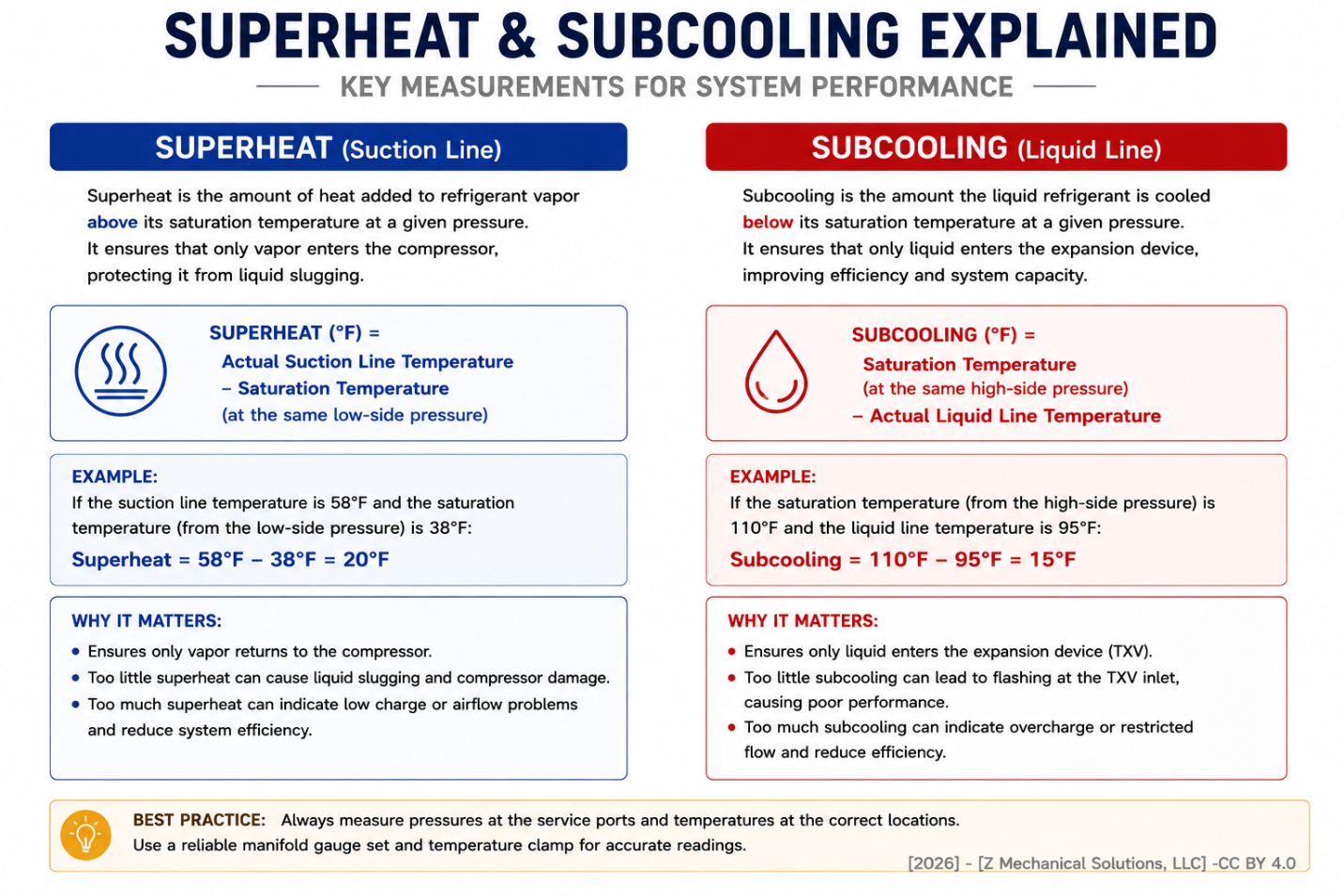
Proper refrigerant charge is evaluated using two important measurements.
Superheat
Superheat is the amount the refrigerant vapor is heated above its saturation temperature after all liquid has evaporated.
Proper superheat:
- Protects the compressor from liquid slugging.
- Indicates complete evaporation.
Subcooling
Subcooling is the amount the liquid refrigerant is cooled below its saturation temperature after condensation.
Proper subcooling:
- Ensures solid liquid reaches the expansion device.
- Improves capacity and efficiency.
- Confirms correct refrigerant charge on many TXV-equipped systems.
Superheat and subcooling are essential commissioning measurements and should always be compared with manufacturer specifications during startup.
Why Air Conditioners Remove Humidity
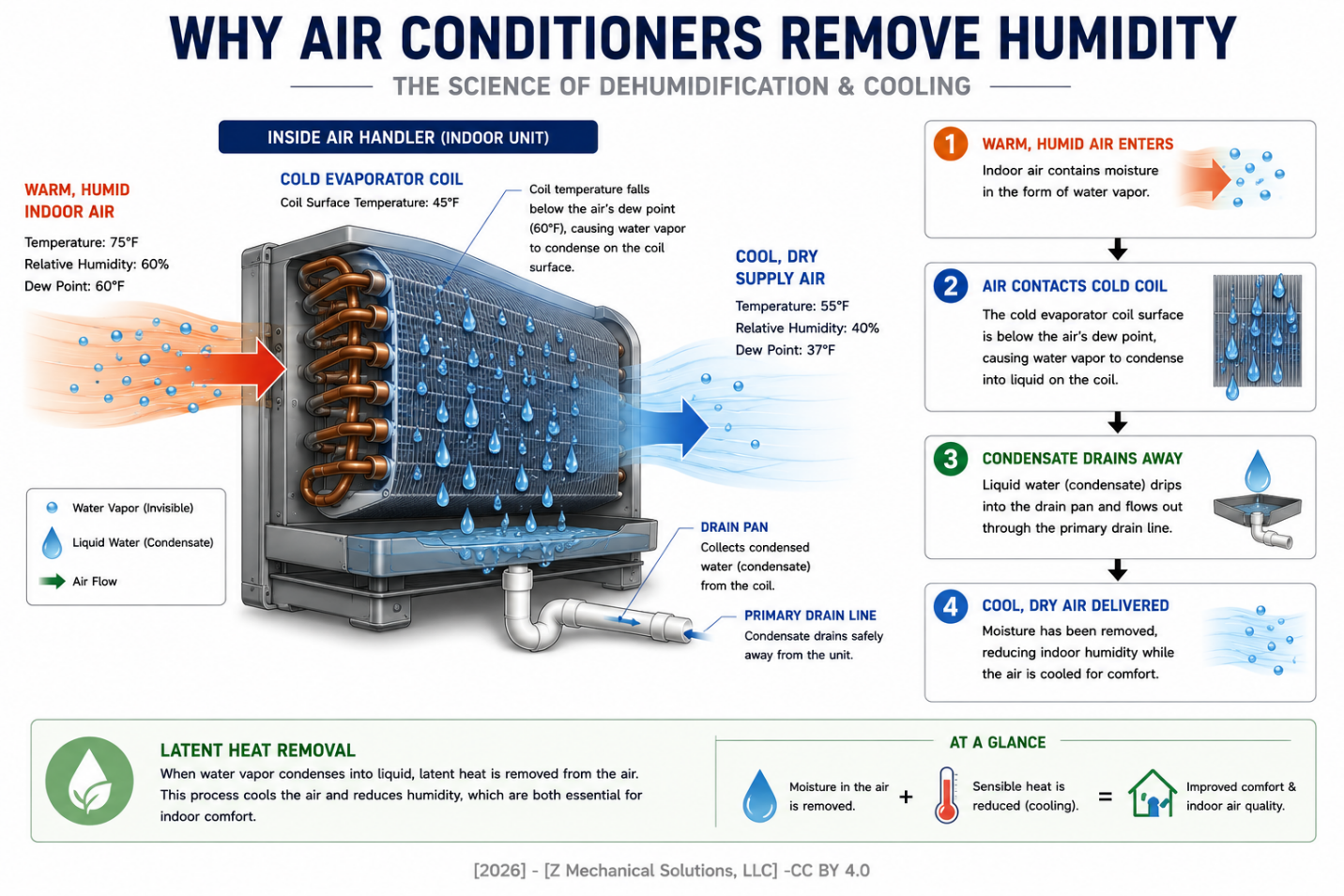
As warm indoor air contacts the cold evaporator coil, the coil temperature often falls below the air's dew point.
Water vapor condenses into liquid water on the coil surface.
The condensate drains through the primary drain line, reducing indoor humidity while simultaneously cooling the air.
This latent heat removal is a significant part of maintaining indoor comfort.
Click to enlarge 🔍
Heat Pumps Operate on the Same Principle
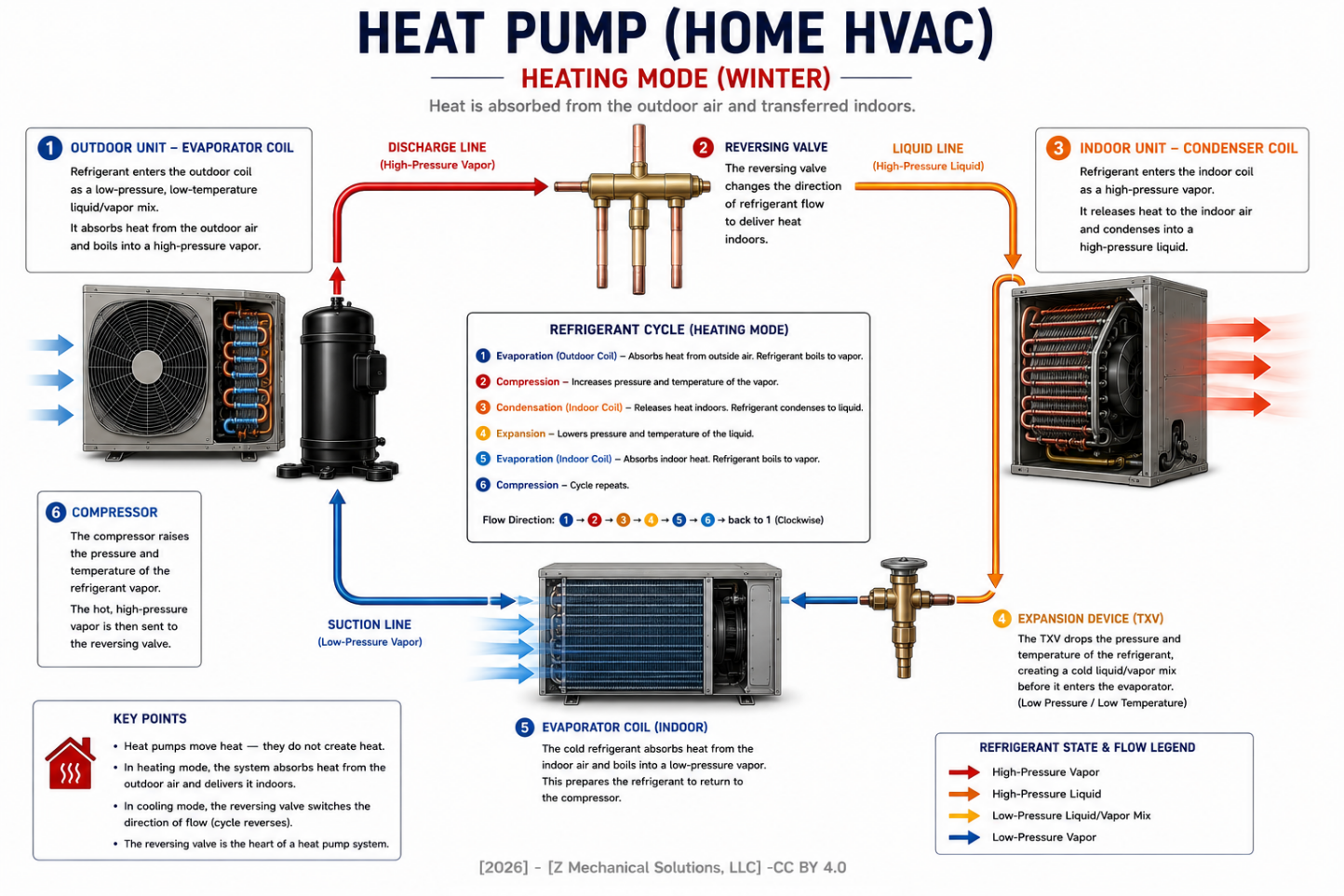
A heat pump uses the exact same vapor compression cycle.
The difference is a reversing valve changes refrigerant flow.
During cooling:
- Indoor coil = evaporator
- Outdoor coil = condenser
During heating:
- Outdoor coil = evaporator
- Indoor coil = condenser
Rather than generating heat, the heat pump transfers heat from the outdoor air—even during cold weather—and delivers it indoors.
Why Proper Installation Matters
Even the highest-efficiency HVAC equipment can perform poorly if installation practices are neglected.
Professional installation should always include:
- Nitrogen purge while brazing
- Proper liquid-line filter drier installation
- Standing nitrogen pressure test
- Deep vacuum (typically below 500 microns)
- Refrigerant charging according to manufacturer specifications
- Verification of superheat and subcooling
- Airflow and thermostat configuration
Proper commissioning ensures long equipment life, maximum efficiency, and reliable system performance.
Final Thoughts
Click to enlarge 🔍
The vapor compression cycle is one of the most successful engineering achievements of the modern era. Every residential air conditioner, commercial rooftop unit, refrigerator, supermarket rack system, and heat pump relies on the same four fundamental processes: evaporation, compression, condensation, and expansion.
For HVAC technicians, understanding the refrigeration cycle goes beyond memorizing components. Mastering the relationships between pressure, temperature, phase change, superheat, and subcooling is the foundation of accurate diagnostics, proper commissioning, and professional system performance.
At Z Mechanical Solutions, LLC, we believe that a strong understanding of refrigeration theory leads to better installations, more effective troubleshooting, and higher-quality HVAC/R service.